
- admin
- March 6, 2026
In recent years, “multi-club ownership” has become a familiar term in football: a single investor or group holding multiple clubs at the same time. The rise of this trend is easy to understand—football is no longer only about competition; it is also a business. A report by the Union of European Football Associations (UEFA) also notes that many clubs in Europe’s “Big Five” leagues are linked to external capital such as private equity funds. As capital increases, club acquisitions and multi-club networks naturally become more common.
The appeal of the multi-club model lies in synergy. Clubs can share resources such as scouting, data analytics and marketing, reducing costs and improving efficiency. Young players can also gain experience in lower-pressure environments before moving to a flagship club or being sold externally. For investors, allocating clubs across regions and tiers can also help diversify risk.
However, the most sensitive issue is fairness. If clubs under the same group meet in the same European competition in the same season, concerns about conflicts of interest are inevitable. UEFA therefore requires that the same person or company must not simultaneously exercise control or decisive influence over two clubs participating in the same UEFA competition. In recent years, enforcement has become stricter: the compliance check has been brought forward to 1 March each year, and the Court of Arbitration for Sport (CAS) has supported a tougher approach in multiple cases. This reflects a clear regulatory direction—earlier and stricter safeguards to maintain both the perceived and the actual integrity of competitions.
As multi-club ownership becomes more widespread and rules become stricter, disputes are also likely to increase. These disputes often involve cross-border contracts, shareholding structures, sponsorships and transfers. The industry therefore needs a faster, more professional and trusted channel to prevent disputes from turning into prolonged litigation that affects operations and reputations.
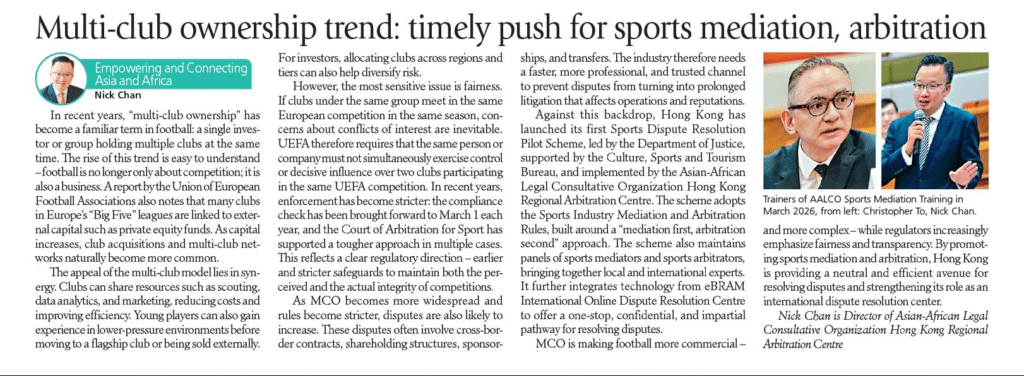
Against this backdrop, Hong Kong has launched its first Sports Dispute Resolution Pilot Scheme, led by the Department of Justice, supported by the Culture, Sports and Tourism Bureau, and implemented by the AALCO Hong Kong Regional Arbitration Centre (AALCO-HKRAC). The scheme adopts the Sports Industry Mediation and Arbitration Rules, built around a “mediation first, arbitration next” approach. The scheme also maintains panels of sports mediators and sports arbitrators, bringing together local and international experts. It further integrates technology from eBRAM International Online Dispute Resolution Centre to offer a one-stop, confidential and impartial pathway for resolving disputes.
Multi-club ownership is making football more commercial—and more complex—while regulators increasingly emphasise fairness and transparency. By promoting sports mediation and arbitration, Hong Kong is providing a neutral and efficient avenue for resolving disputes, and strengthening its role as an international dispute resolution centre.