- aalco_office
- January 9, 2026
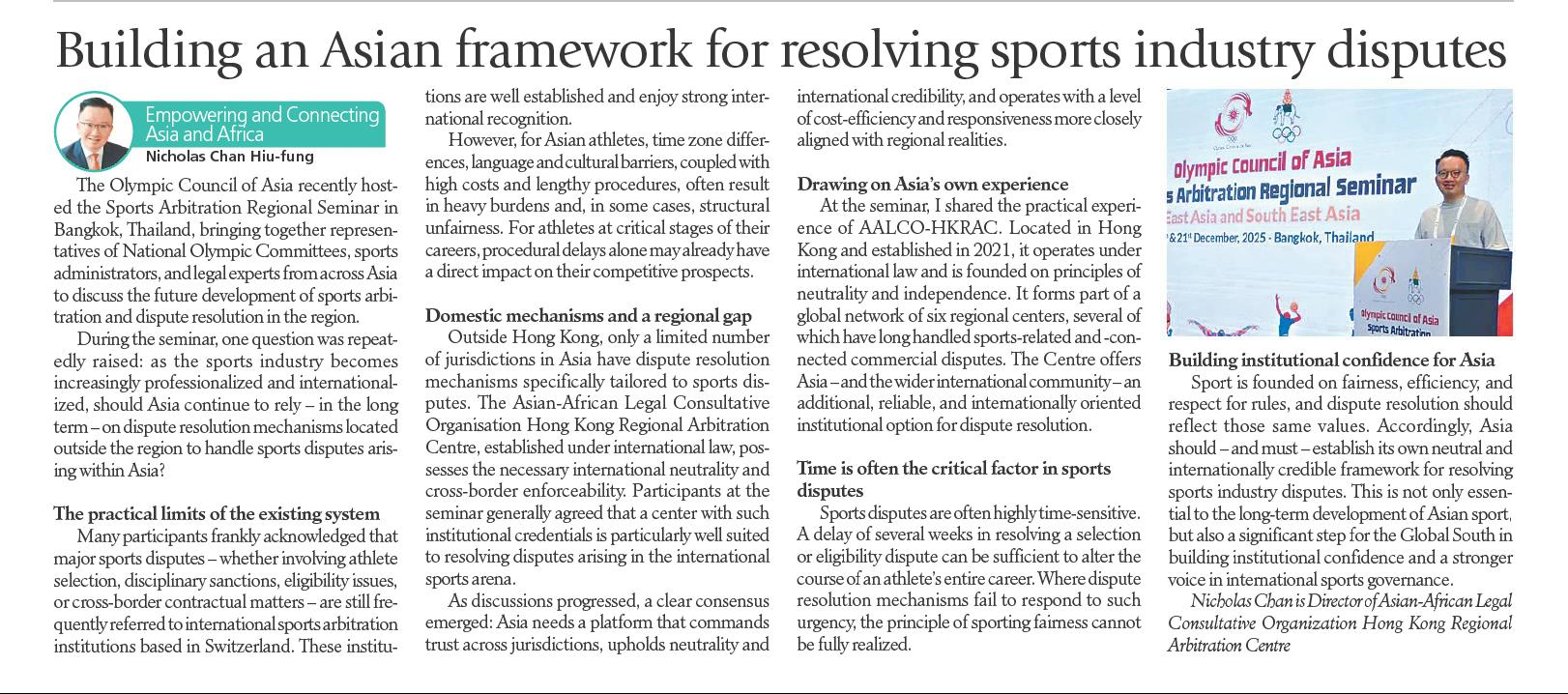
The Olympic Council of Asia recently hosted the Sports Arbitration Regional Seminar in Bangkok, Thailand, bringing together representatives of National Olympic Committees, sports administrators, and legal experts from across Asia to discuss the future development of sports arbitration and dispute resolution in the region.
During the seminar, one question was repeatedly raised: as the sports industry becomes increasingly professionalised and internationalised, should Asia continue to rely in the long term on dispute resolution mechanisms located outside the region to handle sports disputes arising within Asia?
The Practical Limits of the Existing System
Many participants frankly acknowledged that major sports disputes—whether involving athlete selection, disciplinary sanctions, eligibility issues, or cross‑border contractual matters—are still frequently referred to international sports arbitration institutions based in Switzerland. These institutions are well established and enjoy strong international recognition.
However, for Asian athletes, time zone differences, language and cultural barriers, coupled with high costs and lengthy procedures, often result in heavy burdens and, in some cases, structural unfairness. For athletes at critical stages of their careers, procedural delays alone may already have a direct impact on their competitive prospects.
Domestic Mechanisms and a Regional Gap
Outside Hong Kong, only a limited number of jurisdictions in Asia have dispute resolution mechanisms specifically tailored to sports disputes. Asian‑African Legal Consultative Organisation Hong Kong Regional Arbitration Centre (AALCO‑HKRAC), established under international law, possesses the necessary international neutrality and cross‑border enforceability. Participants at the seminar generally agreed that a centre with such institutional credentials is particularly well suited to resolving disputes arising in the international sports arena.
As discussions progressed, a clear consensus emerged: Asia needs a platform that commands trust across jurisdictions, upholds neutrality and international credibility, and operates with a level of cost‑efficiency and responsiveness more closely aligned with regional realities.
Drawing on Asia’s Own Experience
At the seminar, I shared the practical experience of AALCO‑HKRAC. Located in Hong Kong and established in 2021, the Centre operates under international law and is founded on principles of neutrality and independence. It forms part of a global network of six regional centres, several of which have long handled sports‑related and sports‑connected commercial disputes. The Centre offers Asia—and the wider international community—an additional, reliable, and internationally oriented institutional option for dispute resolution.
Time Is Often the Critical Factor in Sports Disputes
Sports disputes are often highly time‑sensitive. A delay of several weeks in resolving a selection or eligibility dispute can be sufficient to alter the course of an athlete’s entire career. Where dispute resolution mechanisms fail to respond to such urgency, the principle of sporting fairness cannot be fully realised.
Building Institutional Confidence for Asia
Sport is founded on fairness, efficiency, and respect for rules, and dispute resolution should reflect those same values. Accordingly, Asia should—and must—establish its own neutral and internationally credible framework for resolving sports industry disputes. This is not only essential to the long‑term development of Asian sport, but also a significant step for the Global South in building institutional confidence and a stronger voice in international sports governance.