
- aalco_office
- December 15, 2025
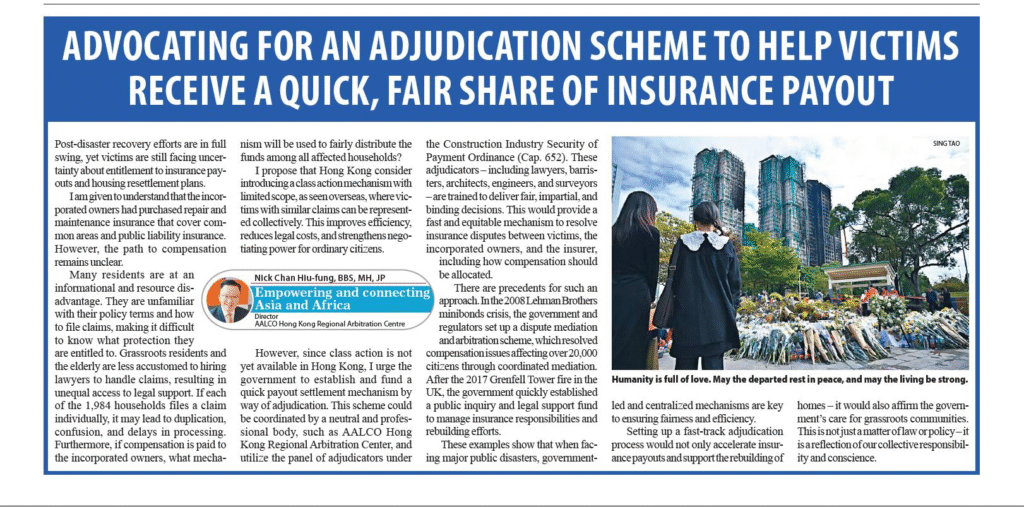
Post-disaster recovery efforts are in full swing, yet victims are still facing uncertainly about entitlement to insurance payouts and housing resettlement plans.
I am given to understand that the incorporated owners has purchased repair and maintenance insurance that cover common areas and public liability insurance. However, the path to compensation remains unclear.
Many residents are at an informational and resource disadvantage. They are unfamiliar with their policy terms or how to file claims, making it difficult to know what protection they are entitled to. Grassroots residents and the elderly are less accustomed to hiring lawyers to handle claims, resulting in unequal access to legal support. If each of the 1,984 households files a claim individually, it may lead to duplication, confusion, and delays in processing. Furthermore, if compensation is paid to the incorporate owners, what mechanism will be used to fairly distribute the funds among all affected households?
I propose that Hong Kong consider introducing class action mechanism with limited scope, as seen overseas, where victims with similar claims can be represented collectively. This improves efficiency, reduces legal costs, and strengthens negotiating power for ordinary citizens.
However, since class action is not yet available in Hong Kong, I urge the government to establish and fund a quick payout settlement mechanism by way of adjudication. This scheme could be coordinated by a neutral and professional body, such as AALCO Hong Kong Regional Arbitration Centre, and utilize the panel of adjudicators under the Construction Industry Security of Payment Ordinance (Cap. 652). These adjudicators — including lawyers, barristers, architects, engineers, and surveyors — are trained to deliver fair, impartial, and binding decisions. This would provide a fast and equitable mechanism to resolve insurance disputes between victims, the incorporated owners, and the insurer, including how compensation should be allocated.
There are precedents for such an approach. In the 2008 Lehman Brothers minibonds crisis, the government and regulators set up a dispute mediation and arbitration scheme, which resolved compensation issues affecting over 20,000 citizens through coordinated mediation. After the 2017 Grenfell Tower fire in the UK, the government quickly established a public inquiry and legal support fund to manage insurance responsibilities and rebuilding efforts.
These international examples show that when facing major public disasters, government-led and centralized mechanisms are key to ensuring fairness and efficiency.
Setting up a fast-track adjudication process would not only accelerate insurance payouts and support the rebuilding of homes — it would also affirm the government’s care for grassroots communities. This is not just a matter of law or policy — it is a reflection of our collective responsibility and conscience.